What Determines IPv4 Pricing in Today’s Market?
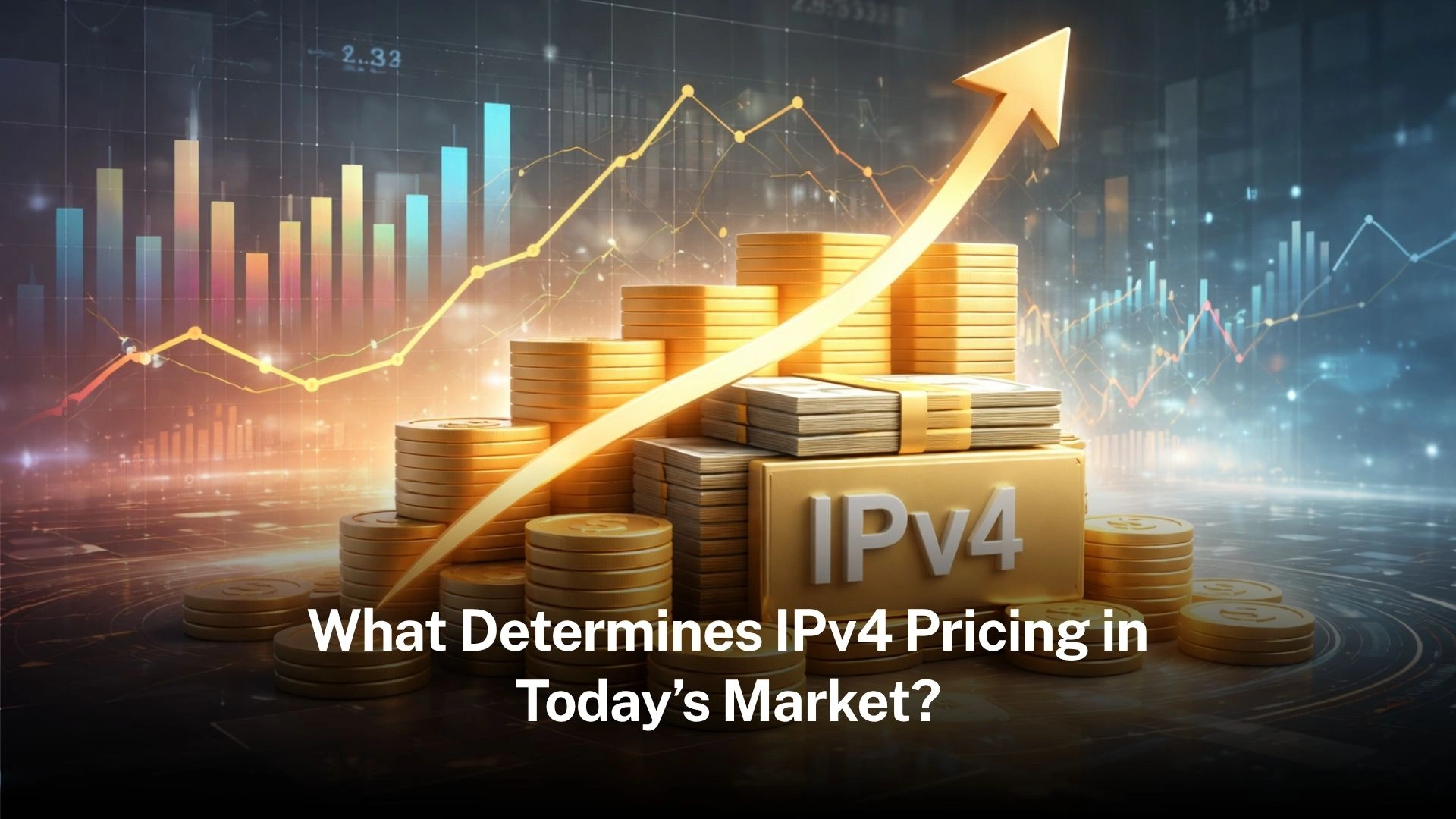
Scarcity, shifting demand, and leasing platforms such as i.lease are reshaping how IPv4 addresses are valued and traded globally.
Table of Contents
Toggle- IPv4 pricing is driven primarily by scarcity, block size, and fluctuating demand across regions and industries.
- Leasing models, including platforms like i.lease, are stabilising costs amid volatile purchase markets.
What determines IPv4 pricing in today’s market
A market shaped by scarcity
IPv4 addresses, once freely allocated, have become a traded digital commodity. As global IPv4 exhaustion took hold over the past decade, a secondary market emerged, where organisations buy, sell, and lease address blocks.
Today, IPv4 pricing reflects a complex interplay of economic scarcity, technical constraints, and institutional arrangements. While the average purchase price in 2025–2026 sits roughly between $30 and $50 per address, the range masks significant variation depending on block size, geography, and usage context.
Leasing, meanwhile, has introduced a more predictable pricing layer. Monthly rates commonly cluster around $0.30 to $0.50 per IP, creating a subscription-like market that contrasts with volatile purchase prices.
The result is not a single “price” for IPv4, but a fragmented market shaped by structural constraints.
Scarcity remains the fundamental driver
The most decisive factor in IPv4 pricing is simple: there are no new addresses.
The IPv4 protocol provides roughly 4.3 billion addresses, and all major allocation pools managed by regional registries have been exhausted since the early 2010s. What remains is redistribution through transfers or leasing.
As one industry analysis notes, “fixed supply, growing demand” underpins price dynamics in the market.
This scarcity has transformed IPv4 from infrastructure into an asset class. Prices surged sharply between 2020 and 2022, reaching as high as $45–$60 per address before moderating in recent years.
Even with temporary price corrections, the structural ceiling imposed by finite supply continues to anchor long-term valuations.
Demand patterns are shifting, not disappearing
While scarcity is constant, demand is not. Instead, it has become more fragmented and cyclical.
The rise of cloud computing, mobile services, and connected devices continues to sustain baseline demand. At the same time, the behaviour of large buyers—particularly hyperscalers—has a disproportionate effect on pricing.
In 2025, for example, total IPv4 transfer volume rose by 28%, while prices fell by around 33%, reflecting reduced aggressive bidding by major players.
This illustrates a key dynamic: demand does not simply push prices upward. It also redistributes market power. When large buyers retreat, smaller participants enter, increasing transaction volume but lowering price pressure.
Block size creates price asymmetry
Not all IPv4 addresses are priced equally. Block size plays a crucial role.
Smaller blocks—such as /24 subnets—typically command higher prices per address than larger blocks like /16s. This reflects flexibility and accessibility: smaller allocations are easier to deploy and finance.
Data from 2025 shows:
- /16 blocks fell to roughly $20–$24 per IP
- /24 blocks remained closer to $30–$33 per IP
This divergence highlights how technical structure intersects with market behaviour. Buyers increasingly favour “right-sized” allocations over large speculative purchases.
Leasing markets bring stability
If the purchase market is volatile, leasing has become its stabilising counterpart.
Leasing allows organisations to access IPv4 addresses without committing to large capital expenditure. Platforms such as i.lease exemplify this shift towards flexible, usage-based access.
Industry data shows leasing prices have remained relatively stable—even during periods of purchase price fluctuation. Rates hovered around $0.40 per IP per month in 2025, with utilisation levels near 80%.
As one market analysis observed, leasing behaves “like a predictable utility” in contrast to the more speculative buying market.
This stability is increasingly attractive for enterprises seeking cost predictability in network planning.
-IPv4 is the Internet’s most important service enabler; a device or server cannot be online without it.
– Heng.Lu, CEO of LARUS Limited and founder of the LARUS Foundation
Geography and policy matter
IPv4 pricing is not globally uniform. Regional policy frameworks and supply constraints introduce further variation.
Different Regional Internet Registries (RIRs) impose distinct transfer rules, affecting liquidity and pricing. For instance:
- North America (ARIN region) often sees stronger demand and higher price support
- Asia-Pacific (APNIC region) can experience tighter supply and higher leasing costs
Policy friction—such as transfer restrictions or compliance requirements—can limit market efficiency, effectively creating regional price differentials.
The “clean IP” premium
Another less visible factor shaping IPv4 pricing is reputation.
Not all IP addresses are equal in operational value. Addresses previously associated with spam, abuse, or blacklisting may trade at a discount, while “clean” IPs command a premium.
As industry commentary notes, “reputation, abuse and the ‘clean IP’ premium” are increasingly embedded in pricing decisions.
This introduces a qualitative dimension into what might otherwise appear to be a purely quantitative market.
IPv6 adoption is not yet a price breaker
In theory, IPv6 should eliminate IPv4 scarcity. In practice, the transition remains slow.
Despite steady growth, there is still “no common sense of urgency” in global IPv6 deployment, and many systems remain dependent on IPv4.
This lag sustains IPv4 demand. Even organisations adopting IPv6 typically run dual-stack environments, maintaining IPv4 compatibility.
As a result, IPv6 has not yet exerted downward pressure sufficient to collapse IPv4 prices. Instead, it acts as a long-term moderating force rather than an immediate substitute.
Market maturity and cyclical pricing
The IPv4 market is no longer in its early speculative phase. It has entered a more mature, cyclical pattern.
Recent years show:
- Price surges (2021–2022) driven by scarcity panic
- Corrections (2023–2025) as supply re-entered the market
- Stabilisation with modest demand growth
Average prices now fluctuate within a narrower band, even as transaction volumes increase.
This suggests a shift from scarcity shock to market equilibrium—though still within the constraints of finite supply.
The role of platforms such as i.lease
Digital marketplaces are increasingly central to how IPv4 pricing is discovered and executed.
Platforms like i.lease facilitate leasing, brokerage, and price transparency, lowering barriers to entry for smaller buyers and sellers.
By aggregating supply and demand, these platforms:
- Improve liquidity
- Standardise pricing signals
- Enable flexible access models
In doing so, they reshape the structure of the IPv4 market itself—moving it closer to a service economy rather than a purely asset-based one.
Conclusion: a market defined by constraints
IPv4 pricing today is not determined by a single factor, but by a layered system:
Absolute scarcity sets the ceiling
Demand cycles drive volatility
- Block size and reputation shape micro-pricing
- Leasing platforms introduce stability
- Policy and geography fragment the market
The result is a market that is both mature and unstable—stable in structure, but sensitive to shifts in behaviour and policy.
As long as IPv4 remains essential and IPv6 adoption incomplete, this hybrid system of scarcity and service will continue to define pricing.
Frequently Asked Questions
Because the supply is fixed and fully allocated, while demand continues from businesses needing compatibility with existing infrastructure.
Typically $30–$50 per address to buy, or about $0.30–$0.50 per month to lease, depending on conditions.
Leasing offers flexibility and predictable costs, while buying involves higher upfront investment but long-term ownership.
Not significantly yet. IPv6 adoption is gradual, and most networks still rely on IPv4 compatibility.
Key factors include block size, regional policy, IP reputation, demand cycles, and whether the addresses are bought or leased.
Related Blogs
Finite IPv4 supply, persistent demand, and slow IPv6 transition are turning IP addresses into tradable assets shaping telecom economics globally. IPv4 Read more
Scarcity, shifting demand, and leasing platforms such as i.lease are reshaping how IPv4 addresses are valued and traded globally.IPv4 pricing is driven Read more
IPv4 scarcity continues to shape internet infrastructure, with /24 blocks still trading actively on global markets despite growing IPv6 adoption. Key Read more
Finite IPv4 supply, persistent demand, and slow IPv6 transition are turning IP addresses into tradable assets shaping telecom economics globally. IPv4 Read more
IPv4 scarcity continues to shape internet infrastructure, with /24 blocks still trading actively on global markets despite growing IPv6 adoption. Key Read more
Despite IPv6 expansion, scarcity keeps IPv4 valuable, sustaining a global secondary market where addresses increasingly function as tradable digital assets.Finite Read more