How Law Enforcement Tracks Hackers and Telco Scammers: Tools & Techniques

Cybercrime is on the rise, with hackers and telco scammers using sophisticated methods to hide their identities. Law enforcement agencies rely on advanced IP tracking tools, forensic analysis, and cyber intelligence to trace and catch these criminals. In this article, we’ll explore the top tools and techniques used by authorities worldwide to track down cybercriminals.
Table of Contents
ToggleIP Tracking & Geolocation Tools
To pinpoint the location of a hacker, authorities use IP tracking and geolocation tools such as MaxMind GeoIP, IPinfo.io, and Whois Lookup. These tools provide insights into an IP address’s physical location, associated ISP, and network details. Shodan and Censys further help by scanning connected devices to reveal potential vulnerabilities that hackers might exploit.
Network Traffic Analysis & Packet Capture
Monitoring real-time network traffic is essential in cybercrime investigations. Tools like Wireshark, Tcpdump, and Zeek (Bro IDS) allow law enforcement to capture and analyze network packets, helping to identify malicious activity. These tools can detect unauthorized connections, suspicious data transfers, and unusual traffic spikes that may indicate cybercrime activities.
Digital Forensics & Log Analysis
Cybercriminals often leave digital footprints that can be uncovered through forensic analysis. Tools like Autopsy, X-Ways Forensics, and Splunk help authorities analyze logs, recover deleted files, and trace an attacker’s movements. ELK Stack (Elasticsearch, Logstash, Kibana) and Graylog provide powerful log monitoring capabilities, assisting in tracking hacker activities over time.
OSINT (Open-Source Intelligence) Tools
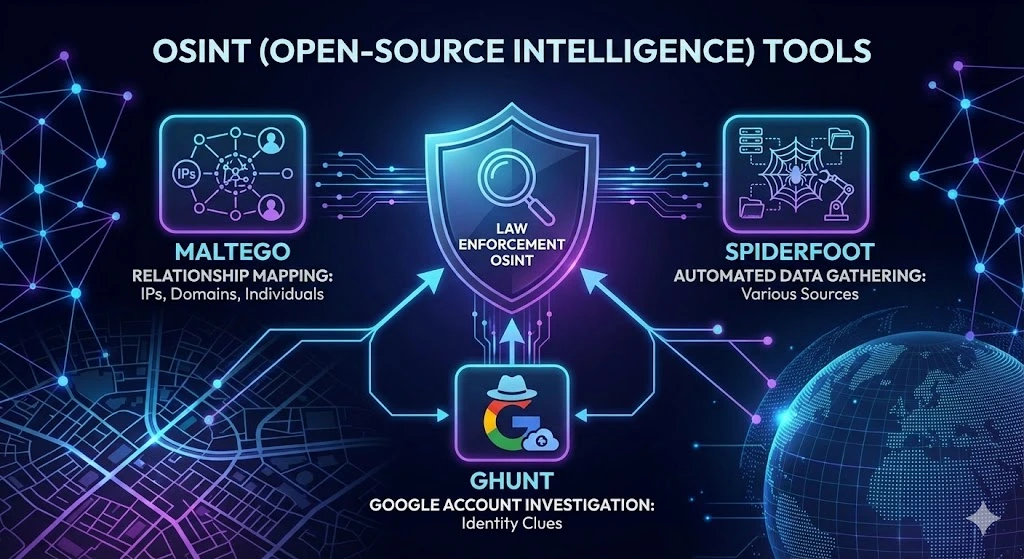
Law enforcement leverages OSINT tools to collect intelligence from publicly available sources. Maltego helps map relationships between IPs, domains, and individuals, while SpiderFoot automates data gathering from various sources. Additionally, GHunt can investigate Google account activity, providing valuable clues about a suspect’s identity.
Tor & Dark Web Monitoring
Hackers and scammers frequently use Tor and dark web platforms to operate anonymously. Tools like Ahmia and OnionScan assist in uncovering hidden services, while CipherTrace and Chainalysis track cryptocurrency transactions linked to cybercrime. Law enforcement also employs ShadowDragon to monitor darknet activities and uncover criminal networks.
ISP Collaboration & Legal Requests
One of the most effective ways to trace hackers is through ISP collaboration. Law enforcement agencies issue subpoenas and MLAT (Mutual Legal Assistance Treaty) requests to obtain user logs from ISPs. Programs like LEAP (Law Enforcement Access Program) and organizations such as Interpol, FBI, and Europol work together to track cybercriminals across borders.
Anti-VPN & Proxy Detection
Many hackers use VPNs, proxies, or the Tor network to mask their real IP addresses. Tools like IPQualityScore, FraudLabs Pro, and Scamalytics help detect these disguises by identifying suspicious IP patterns, VPN usage, and proxy servers. These solutions help law enforcement unmask hidden attackers.
Honeypots & Cyber Threat Intelligence
To catch cybercriminals, law enforcement deploys honeypots—decoy systems designed to lure hackers. Tools like Dionaea, Cowrie, and T-Pot simulate vulnerable systems, allowing authorities to study attacker behavior. Additionally, AlienVault OTX and VirusTotal provide real-time threat intelligence, helping to identify and block malicious IP addresses.
Advanced & Government-Level Tracking
Top intelligence agencies employ advanced surveillance programs to track cybercriminals worldwide. XKeyscore (NSA tool) and PRISM (U.S. surveillance program) collect vast amounts of internet data. Echelon, a global surveillance system, monitors communications for national security threats. Meanwhile, Palantir Gotham integrates AI-powered analytics for large-scale investigations.
How Law Enforcement Tracks Hackers & Scammers
To successfully track and apprehend cybercriminals, law enforcement follows a multi-layered approach. This includes IP geolocation tracking, ISP subpoenas, network traffic analysis, OSINT research, and social engineering tactics. Some agencies conduct undercover dark web operations to infiltrate hacking forums and identify criminal masterminds. By combining cutting-edge technology with intelligence collaboration, authorities can track and prosecute hackers effectively.
Final Thoughts
As cyber threats continue to evolve, so do the tools and techniques used by law enforcement to track and locate hackers and scammers. By leveraging IP tracking, digital forensics, OSINT, honeypots, and dark web monitoring, authorities can uncover cybercriminal networks and bring them to justice. If you’re in cybersecurity, law enforcement, or digital forensics, staying ahead of these trends is critical to combating online threats.
Trusted IPv4 Leasing for Business Growth
Get enterprise-grade IPv4 space quickly, with seamless deployment and end-to-end management.
Buying IPv4 addresses outside proper IP Allocation channels exposes organisations to fraud, legal disputes, operational failures and long-term governance risks.Key Read more
Facing IPv4 shortages, companies must weigh cost, speed, and network growth when choosing a lease plan.Short-term leasing lets you scale Read more
IPv4 地址曾经只是互联网运行所需的基础资源。但在今天,它越来越像一种具有市场价格、可交易、可租赁的数字资产。造成这一变化的原因并不复杂:IPv4 的总量有限,而全球互联网对 IPv4 的需求并没有消失;与此同时,IPv6 虽然早已出现,但迁移进度依然缓慢。这三股力量叠加,正在重新塑造运营商对 IP 地址的看法,也改变了互联网基础设施的经济逻辑。原文将这点概括为“有限供给、持续需求与缓慢转型”,并指出这正在推动 IP 地址成为影响全球电信经济的可交易资产。 IPv4 稀缺并不是新问题 全球互联网至今仍大量依赖 IPv4。这个协议诞生于更早的时代,只能提供大约 43 亿个地址。这个数量在互联网初期似乎足够庞大,但在今天已经明显不够。原文指出,IANA 在 2011 年就已将最后一批大型 IPv4 Read more