Direcciones IP de centros de datos frente a direcciones IP residenciales: ¿Cuál es la diferencia y por qué es importante?
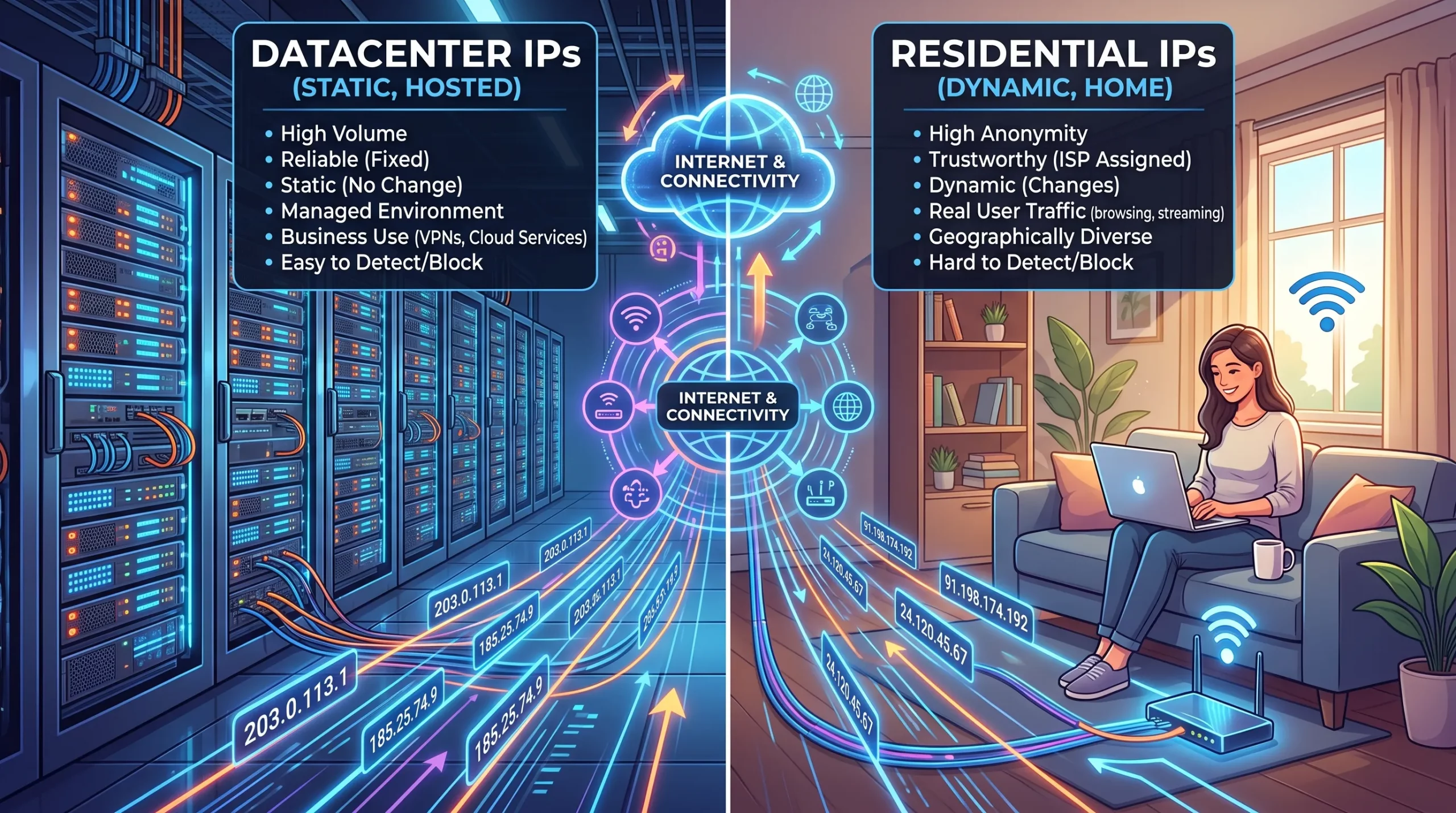
A data center IP address originates from a commercial data center, cloud provider, or hosting company, while a residential IP address is assigned by an internet service provider to a home or business user. The difference lies in the origin: one comes from infrastructure designed to run servers; the other, from a connection designed to serve an end user. This single distinction determines how the rest of the internet handles traffic from each.
Table of Contents
ToggleThe topic is often discussed only within the narrow context of proxies and anti-detection, which presents a distorted picture. In reality, the difference between datacenter and residential IP addresses matters to anyone operating internet infrastructure because it determines the level of implicit trust an address carries, how websites and security systems respond to it, and what kind of use it’s suitable for. Virtually all legitimate enterprise infrastructure—every website, API, mail server, and cloud service you use—runs on datacenter IP space, and that’s exactly the right thing to do. The issue isn’t that one type is good and the other bad; they serve different purposes and are treated differently. Knowing which one you have, or which one you need, prevents a lot of unnecessary problems.
This article explains what each type is, how systems distinguish between them, why they are treated differently, and what this distinction means for companies deploying real-world services over public IPv4 address space, including how it relates to address reputation, geolocation, and the type of address space that each use case actually requires.
Datacenter vs residential: the short answer
Data center IPs originate from hosting and cloud infrastructure and are recognized as such; Residential IPs originate from consumer ISP connections and are interpreted as normal end users. The practical consequences of this distinction are as follows:
- Data center IPs are plentiful, fast, stable, and inexpensive to acquire in bulk, and they are easily identifiable as belonging to hosting infrastructure. These are the addresses on which servers and services operate.
- Residential IPs are tied to real consumer connections, appear to websites as normal users, and are harder to obtain in large quantities, although they are typically less stable and slower than data center space.
Neither type is inherently superior. A web server should operate on a data center IP address; that’s what that type of address is designed for. The difference only becomes a real deciding factor in specific situations, primarily when the goal is to make traffic appear to originate from a regular consumer rather than infrastructure—a far more specialized need than many explanations suggest.
What is a data center IP address?
A data center IP address is any address that originates from a commercial data center, cloud provider, or hosting company, rather than a consumer ISP connection. These addresses are allocated in large blocks to hosting and cloud companies, and any server running on that infrastructure uses a data center IP address.
Its characteristics are derived from its purpose: to run servers at scale:
- Abundant and easy to supply. Hosting and cloud providers own large blocks of addresses, so data center IPs can be allocated quickly and in large quantities.
- Fast and stable. They run on professionally operated, high-capacity infrastructure with high availability – exactly what servers need.
- Easily identifiable. Because they belong to well-known hosting and cloud ranges, systems can recognize them as data center addresses; the ASN and registration data reveal their origin.
- Economical. They are the least expensive type of address space to obtain on a large scale.
Data center IPs form the foundation of virtually all services accessible from the internet. When you visit a website, call an API, or connect to a cloud application, you are almost certainly accessing a data center IP. This open identification is not a flaw; for a server, being recognized as infrastructure is perfectly appropriate.
What is a residential IP address?
A residential IP address is one that an Internet service provider (ISP) assigns to a home or business user, associated with an actual consumer connection at a physical location. When a person browses the internet normally from home, the address they see is usually a residential IP address issued by their ISP.
Its characteristics derive from its origin: real consumer connections:
- They are interpreted as regular users. Because they belong to ISP consumer ranges, websites treat them as regular end users rather than infrastructure.
- Higher initial level of trust. They represent real people connecting from real locations, so trust systems tend to give them more benefit of the doubt by default.
- Linked to a physical geography. They correspond to the current locations of subscribers, providing a more meaningful and consistent geolocation.
- Often dynamic and less stable. ISPs frequently rotate customer addresses, and residential connections are not designed for the availability or performance of servers.
- More difficult to obtain in quantity. They are allocated to consumers and not distributed on a massive scale, so large residential pools are scarcer and more expensive than data center space.
One specialized category, residential proxies , routes traffic through residential IPs to make it appear to originate from ordinary home users. Ethical services in this area obtain their addresses from users who have genuinely consented to participate; the legitimacy of the source is a real and important differentiator, as alternatives raise clear consent issues.
Datacenter vs residential: a complete comparison
| Factor | IP Data Center | Residential IP |
|---|---|---|
| Origin | Data center / cloud / hosting provider | ISP connection for consumers |
| It appears on websites as | Infrastructure / server | Normal end user |
| Implicit level of confidence | Lower by default (clearly identifiable infrastructure) | Higher by default (real user) |
| Speed and stability | High — designed for servers | Variable — designed for consumers |
| Volume availability | Abundant, easy to supply | Scarce, harder to obtain |
| Cost per address | Lower | Higher |
| Geolocation | Data center location | Subscriber’s actual location |
| More suitable for | Server hosting and services | Appear as a consumer user |
The balance essentially boils down to trust versus performance and availability. Data center space wins in speed, stability, scale, and cost; residential space wins when you need to appear as a regular user and benefit from greater initial trust. Each is aligned with the purpose for which it was designed.
How the systems distinguish them
Websites and security systems primarily distinguish between data center and residential IPs by checking which organization an address belongs to and whether that organization is a hosting provider. Several indicators are involved in this determination:
- ASN and registration data. Every routed address is advertised by an autonomous system, identified by an ASN . If the ASN and registrations belong to a known hosting or cloud provider, the address is interpreted as datacenter; if they belong to a consumer ISP, it is interpreted as residential. This is the primary and most reliable indicator.
- Known hosting ranges. Discovery services maintain data on which blocks of addresses belong to hosting and cloud providers, so an address included in those ranges is marked as a data center, often by a simple “is hosting” indicator.
- Reverse DNS and other metadata. The reverse DNS name and other related records can strengthen the ranking, as hosting infrastructure and residential connections often use distinctly different naming conventions.
The key takeaway is that the classification isn’t primarily based on guessing behavior; it relies heavily on queries of public registry and routing data. The type of an address is, in practice, reflected in the records describing who owns it and who advertises it, which explains why this distinction is so consistent and so difficult to conceal.
Why do they receive different treatments?
Systems treat data center and residential IPs differently because the origin of an address is a useful signal about the likely nature of the traffic, even if it is only a signal and not a verdict.
The reasoning is statistical. Automated traffic—bots, scrapers, and high-volume tools—runs disproportionately over data center infrastructure because it’s cheap and easy to operate at scale there. Normal human browsing comes disproportionately from residential connections. Therefore, a site attempting to distinguish real users from automation reasonably uses address type as one of its factors: data center traffic receives more scrutiny—stricter speed limits, CAPTCHA challenges, and more detailed logs—while residential traffic receives more initial trust.
Two important nuances help to keep this distinction in perspective:
- Datacenter does not mean malicious. The vast majority of datacenter traffic is completely legitimate; every API integration, monitoring service, and cloud application runs on datacenter IP. The responsible systems considered the “datacenter” signal as one factor within a broader assessment, not as sufficient grounds for blocking on its own.
- Trust is not identity. Higher initial trust in a residential IP address is a heuristic, not proof of a genuine user behind it, just as lower initial trust in a data center IP address doesn’t prove it’s a malicious actor. These are initial assumptions that good systems refine with other evidence, including the current reputation of the address.
That’s why address reputation matters, along with address type: a clean and well-used data center IP can gain trust over time, while any type of address can lose it through abuse. The type determines the starting point; behavior changes it.
What is each type really used for?
The correct addressing type depends on whether your traffic should be presented as infrastructure or as a regular consumer. From a legitimate uses perspective:
Data center IPs are the right choice for:
- Hosting websites, APIs, and applications — any service designed to be publicly accessible.
- Mail servers, DNS servers, VPN endpoints, and other infrastructure services.
- Virtually any type of cloud or server workload.
- Any scenario in which it is appropriate to be identified as infrastructure, that is, most business services.
Residential IPs are a specialized option for:
- Legitimate use cases where traffic really needs to look like that of a normal consumer, such as checking how a site, ad, or price appears to real users in a specific location — advertising verification, brand protection, market research, and QA testing.
- Data collection with consent in objectives that closely examine the origin of the network and where the data center space would be treated as automation.
The key correction to much of the existing content on this topic is this: for the vast majority of enterprise infrastructure, data center IPs are not a compromise; they are the right answer. Residential space regarding is a specialized tool for the smaller set of cases where appearing as a consumer is truly necessary, and those cases involve real responsibilities consent, legality, and adherence to terms of service.
Where do ISP and mobile addresses fit in?
Between the data center and residential extremes there are two hybrid categories: ISP addresses (static residential) and mobile addresses.
Static residential/ISP addresses have residential characteristics—they are associated with ISP customer ranges and are interpreted as residential—but are hosted on datacenter-grade infrastructure to offer greater stability and speed. The goal is to combine the reliability of residential addresses with the performance of datacenter hosting. They occupy a middle ground: more stable than true residential addresses and with higher initial reliability than a conventional IP datacenter.
Mobile addresses come from mobile operator networks, where many devices typically share addresses behind carrier-level NAT—the same CGNAT mechanism operators use to conserve IPv4. Because a mobile address can be genuinely shared by many real users, it usually receives a high initial level of trust—blocking it could block numerous legitimate users—but it is also less predictable and controllable.
These categories exist because the line between data center and residential is more of a spectrum of trust and control than a strictly binary division. A business’s position within that spectrum—and the cleanliness of its reputation—is what truly determines how it will be treated.
What does this mean for your infrastructure?
For most companies, the practical recommendation is simple: run your services on high-quality, reputable data center IPv4 space, and treat residential space as a specialized tool for specific legitimate cases that really require it.
Some important implications:
- Your services need to run in data center space, and that’s perfectly fine. Worrying about data center IPs having “lower trust” misinterprets the situation in the context of infrastructure. A mail server, an API, or a website should look like infrastructure. The important thing isn’t to hide its nature, but to ensure the address space is clean, well-structured, and reputable.
- For most uses, reputation and structure matter more than type. A clean, reputable data center IP with proper records performs better than a disreputable address of any type. For infrastructure, focus on reputation , proper reverse DNS, and correct routing, not on trying to look residential.
- For legitimate use cases that should appear consumer-oriented, address quality is crucial. When a use case truly requires residential-grade address space or large, well-structured data center pools—such as consent-based data collection at scale—the quality, reputation, and structure of the address space make the difference between a reliable operation and one that ends up blocked. As we explained in our guide on proxy vs. VPN , the tool matters far less than the addresses behind it, and the same holds true here.
- Match the address type to the current requirement. Deploying a server in residential space conflicts with that type’s inherent instability; to appear consumer-oriented from data center space conflicts with its ease of identification. Choosing the right type for the job avoids both of these issues.
This is where the issue of address quality intersects with that of acquisition. Companies that need large amounts of reputable data center IPv4 addresses—for hosting, services, or legitimate large-scale data operations—are increasingly obtaining them through leasing or purchase, rather than being limited to what a single provider allocates. Structured leasing of IPv4 blocks provides reputationally vetted and properly structured address space, along with the routing and reputation support required in a production environment, while companies with stable, long-term needs may choose to purchase IPv4 addresses outright. In either case, the important decision isn’t so much “datacenter or residential” in the abstract, but rather, “Is this address space clean, well-structured, and truly suited to what I’m doing?”
i.lease practical note
The distinction between datacenter and residential IPs is genuinely useful, but the way it’s often framed can lead businesses astray. Much of the content on this topic comes from the proxy marketplace and presents residential IPs as inherently better because they’re harder to detect, silently assuming that the goal is always to avoid detection. For the vast majority of legitimate infrastructure, this is the opposite. A business hosting services needs clean, fast, stable, reputable, reliable, and properly logged address space, and that’s precisely what datacenter space delivers when it’s functioning correctly.
Where the distinction truly matters is in the quality of the address, not simply its type. Whether you’re running servers on data center IP or operating a legitimate data collection pipeline that requires specific address characteristics, the outcome depends far more on reputation, structure, and proper routing than on the address’s nominal category. A flagged, poorly structured block will perform worse regardless of the type; a clean, well-managed block will perform well regardless of the type. That’s the perspective worth applying: not “which type is better,” but “is this address space clean, properly structured, and suitable for what I’m actually doing?” Answer that question well, get the right address space, and the datacenter-versus-residential debate becomes what it should be: a practical matter of matching the address to its purpose.
Conclusions
Data center IP addresses and residential IP addresses differ in their origin—hosting infrastructure versus consumer ISP connections—and that origin determines how the internet interprets them: as infrastructure or as regular users. Systems primarily distinguish between them by consulting the ASN and registration data, and treat them differently because the origin of an address is a useful statistical signal about the nature of the traffic, although never conclusive proof. Data center IP address space is abundant, fast, and clearly identifiable as infrastructure; residential IP address space appears as real users and is initially more trusted, but is scarcer and less stable.
The practical conclusion contradicts the proxy marketing approach that dominates this topic. For virtually all legitimate enterprise infrastructure, data center IP space is the right choice, not a compromise; a server should present itself as a server. Residential space is a specialized tool for specific, legitimate use cases where appearing as a consumer is truly a requirement, along with the legal consent and usage responsibilities that entails. And underlying the type difference is an even more important factor in all cases: the reputation, structure, and proper configuration of the address space itself. Match type to purpose, demand clean and well-structured space, and the data center-versus-residential question becomes what it should be: a simple matter of choosing the right address for the job.
You can also read:
Frequently Asked Questions
A datacenter IP originates from a commercial data center, cloud, or hosting provider, while a residential IP is assigned by an ISP to a home or business subscriber. Websites read datacenter IPs as infrastructure and residential IPs as ordinary users, and treat them differently as a result.
Neither is universally better — they serve different purposes. Datacenter IPs are faster, more stable, cheaper, and correct for hosting servers and services. Residential IPs appear as ordinary consumers and carry higher default trust, which matters only for the specific cases where traffic needs to look like a real home user.
Mainly by looking up the address’s ASN and registration data to see whether it belongs to a hosting or cloud provider, checking it against known hosting ranges, and using metadata like reverse DNS. Because this relies on public routing and registration records, datacenter classification is consistent and hard to disguise.
An ISP or static residential address carries residential characteristics — it’s associated with ISP consumer ranges and reads as residential — but is hosted on datacenter-grade infrastructure. It aims to combine residential trust with datacenter stability and speed, sitting between the two main categories.
They carry higher default trust because they represent real users at real locations, but trust is a starting assumption, not proof. A clean, well-behaved datacenter IP earns trust over time, and any address type can lose trust through abuse. Reputation and behavior refine the initial signal that type provides.
It’s generally a poor fit. Residential connections are often dynamic and aren’t built for server-grade uptime or throughput, and many ISP consumer plans restrict hosting. Servers belong on datacenter space, which is built for stable, reachable, high-performance service delivery.
It depends on the target. Datacenter IPs work for targets that don’t scrutinize network origin closely, while residential-type space suits high-trust targets that treat datacenter traffic as automation. In all cases, the reputation and structure of the address space matters more than the type alone, and scraping should respect consent, terms, and applicable law.
For most uses, yes. A clean, well-structured address with good reputation outperforms a poorly-reputed one regardless of type, and a flagged block underperforms regardless of type. Type sets the default starting assumption; reputation, structure, and correct configuration determine actual outcomes.
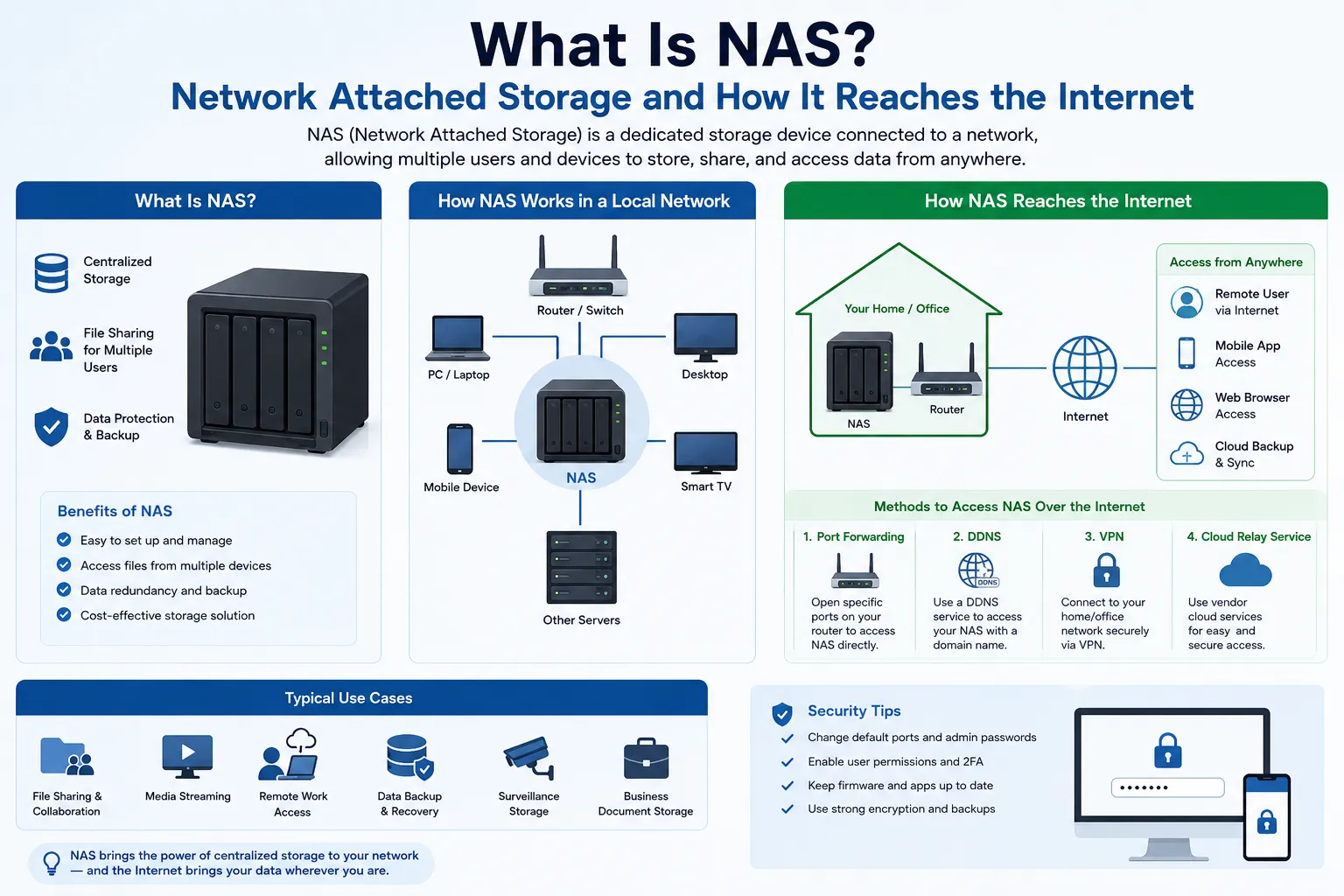
NAS significa Network Attached Storage, o almacenamiento conectado a la red. Es un dispositivo de almacenamiento dedicado que se conecta Read more
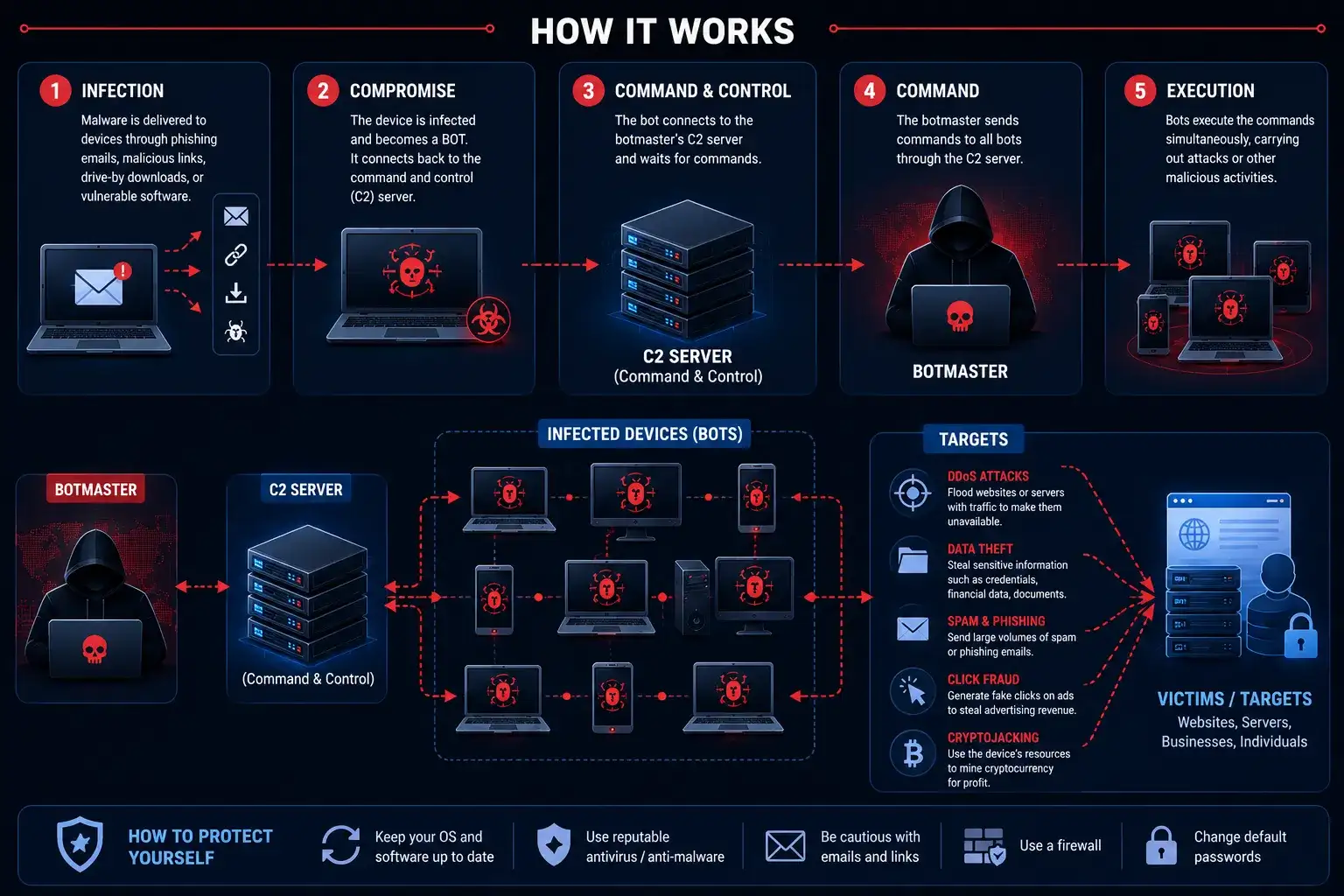
Una botnet es una red de ordenadores o dispositivos comprometidos que ejecutan software malicioso y que permite a un único Read more

Una Carta de Autorización (LOA) es un documento formal mediante el cual el titular registrado de un bloque de direcciones Read more