IoT (Internet of Things) and IP Address Management

When we talk about the Internet of Things, abbreviated IoT, in digital transformation, the Internet of Things (IoT) has emerged as a transformative force, connecting billions of devices and enabling innovative applications across industries. At the heart of this interconnected ecosystem lies IP address management, a critical aspect that ensures the seamless communication and operation of IoT devices.
Table of Contents
Toggle
Let’s delve into the symbiotic relationship between IoT and IP address management, exploring the challenges, strategies, and best practices for effectively managing IP addresses in the IoT landscape.
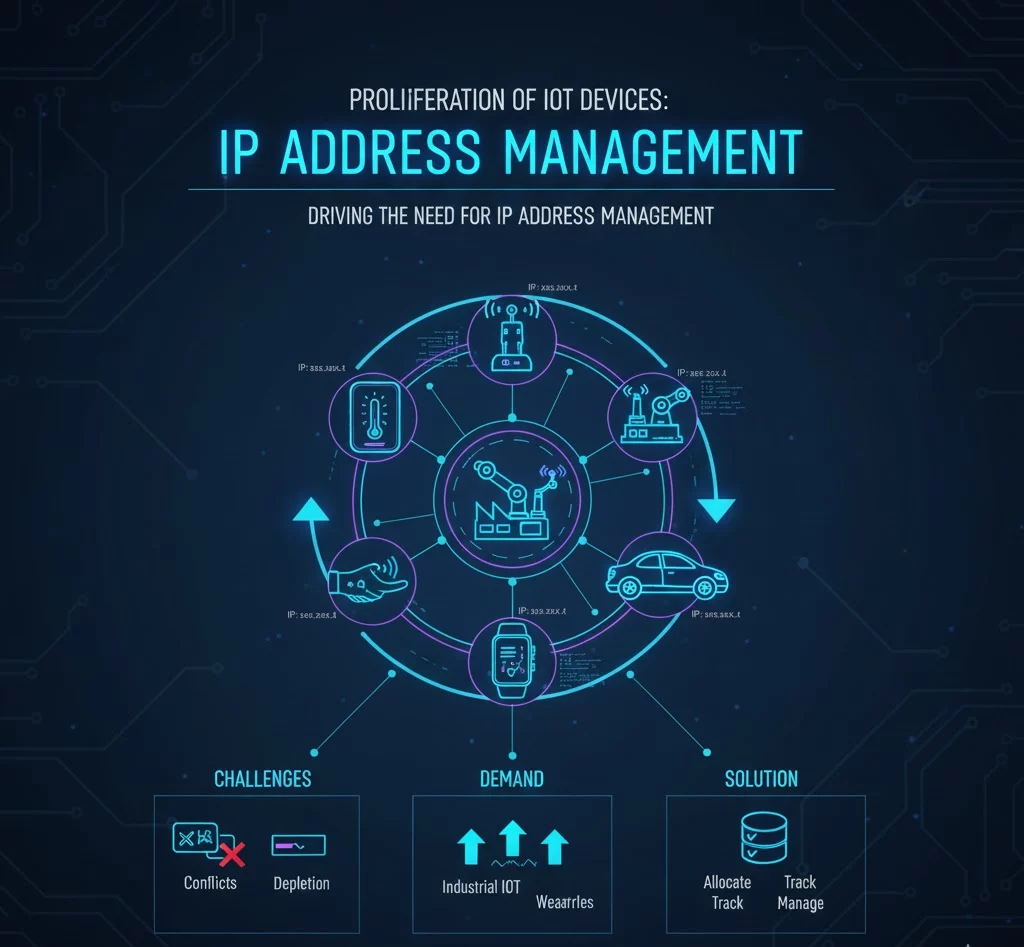
Proliferation of IoT Devices: Driving the Need for IP Address Management
As the number of IoT devices continues to skyrocket, ranging from smart thermostats and wearable devices to industrial sensors and autonomous vehicles, the demand for IP address management has never been greater. Each IoT device requires a unique IP address to communicate and interact with other devices and services over the Internet, necessitating robust IP address management practices to allocate, track, and manage these addresses efficiently. Without effective IP address management, organizations risk facing IP address conflicts, depletion of address space, and network performance issues, hindering the scalability and reliability of their IoT deployments.
Challenges in IoT IP Address Management: Scale, Security, and Scalability
Managing IP addresses in the IoT landscape poses several unique challenges stemming from the sheer scale and heterogeneity of IoT deployments, as well as the security and scalability requirements inherent to IoT applications. With millions, or even billions, of IoT devices interconnected across diverse networks and environments, traditional IP address management approaches may prove inadequate for addressing the dynamic nature of IoT deployments.
Additionally, security concerns, such as unauthorized access, data breaches, and device compromise, underscore the importance of implementing robust authentication, encryption, and access control mechanisms within IoT networks.
Strategies for Effective IoT IP Address Management: Automation and Orchestration
To overcome the challenges of IoT IP address management, organizations are increasingly turning to automation and orchestration solutions that streamline address allocation, provisioning, and lifecycle management processes.
By leveraging automation tools and centralized management platforms, organizations can dynamically assign and reclaim IP addresses based on device provisioning, activation, and decommissioning events, ensuring optimal resource utilization and minimizing manual intervention.
Moreover, orchestration frameworks enable organizations to enforce policy-based IP address assignments, implement role-based access controls, and integrate with existing network infrastructure, thus enhancing security and scalability in IoT deployments.
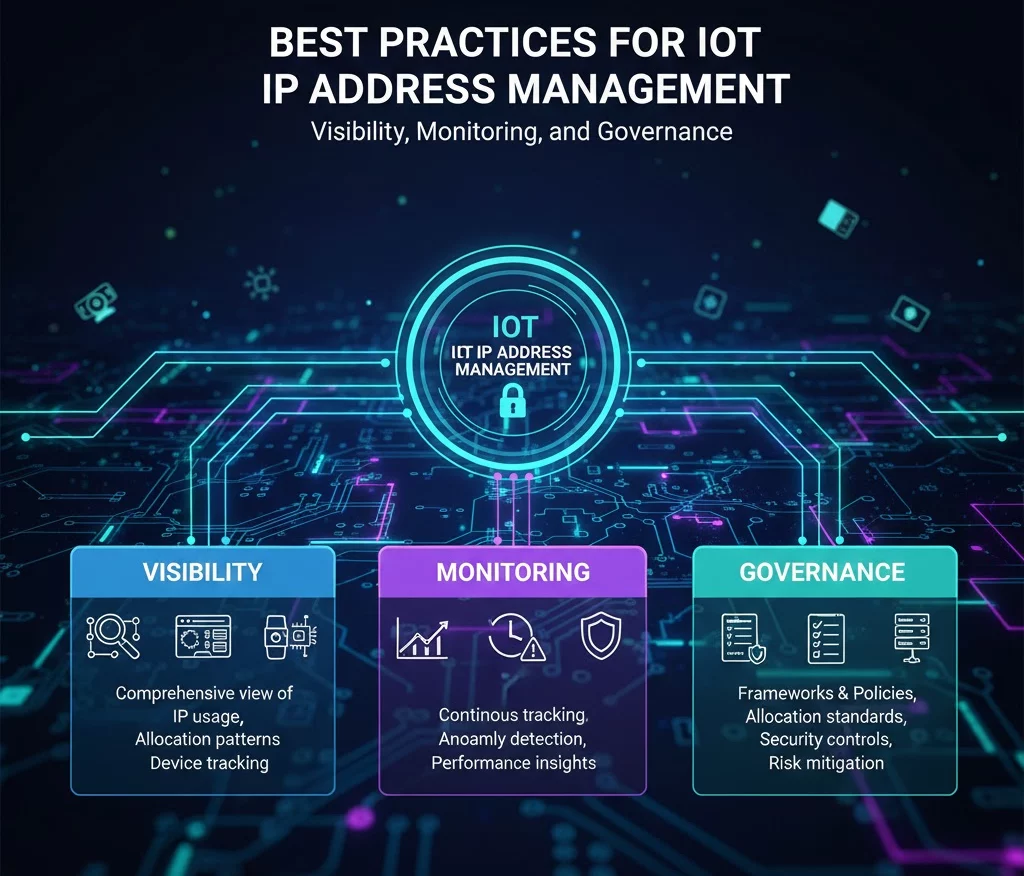
Best Practices for IoT IP Address Management: Visibility, Monitoring, and Governance
In addition to automation and orchestration, adopting best practices for IoT IP address management is essential to ensuring the long-term success and sustainability of IoT deployments. This includes maintaining comprehensive visibility into IP address usage and allocation patterns across IoT devices, networks, and environments.
Furthermore, implementing governance frameworks and policies that define IP address allocation policies, address space management procedures, and security controls can help organizations maintain compliance, enforce standards, and mitigate the risks associated with IP address management in the IoT landscape.
Embracing the Future of IoT with Effective IP Address Management
In conclusion, the convergence of IoT and IP address management heralds a new era of innovation, connectivity, and efficiency in the digital landscape. By addressing the challenges, leveraging automation and orchestration solutions, and adopting best practices, organizations can unlock the full potential of IoT deployments while ensuring the scalability, security, and reliability of their IP address management infrastructure. As IoT continues to reshape industries and redefine connectivity, effective IP address management remains a cornerstone of success in the interconnected world of tomorrow.
Trusted IPv4 Leasing for Business Growth
Get enterprise-grade IPv4 space quickly, with seamless deployment and end-to-end management.
FAQs
Most IoT devices (like smart bulbs or sensors) use Private IP addresses (e.g., 192.168.x.x) to communicate within a local network, connecting to the internet via a gateway. However, industrial IoT devices that require direct remote access often need Public, Static IP addresses to ensure they can be reached reliably from anywhere.
IPv4 has run out of addresses (only ~4.3 billion exist), which is insufficient for the billions of new IoT devices coming online. IPv6 offers a virtually infinite address space (340 undecillion addresses), allowing every single IoT sensor to have its own unique, globally routable IP address without needing complex NAT workarounds.
An IP conflict occurs when two devices on the same network try to use the same IP address, causing both to disconnect. In IoT networks with thousands of devices, this is a common issue if IP management is done manually. Using an automated IPAM (IP Address Management) tool prevents this by tracking which IPs are in use in real-time.
Buying IPv4 addresses outside proper IP Allocation channels exposes organisations to fraud, legal disputes, operational failures and long-term governance risks.Key Read more
Facing IPv4 shortages, companies must weigh cost, speed, and network growth when choosing a lease plan.Short-term leasing lets you scale Read more
IPv4 地址曾经只是互联网运行所需的基础资源。但在今天,它越来越像一种具有市场价格、可交易、可租赁的数字资产。造成这一变化的原因并不复杂:IPv4 的总量有限,而全球互联网对 IPv4 的需求并没有消失;与此同时,IPv6 虽然早已出现,但迁移进度依然缓慢。这三股力量叠加,正在重新塑造运营商对 IP 地址的看法,也改变了互联网基础设施的经济逻辑。原文将这点概括为“有限供给、持续需求与缓慢转型”,并指出这正在推动 IP 地址成为影响全球电信经济的可交易资产。 IPv4 稀缺并不是新问题 全球互联网至今仍大量依赖 IPv4。这个协议诞生于更早的时代,只能提供大约 43 亿个地址。这个数量在互联网初期似乎足够庞大,但在今天已经明显不够。原文指出,IANA 在 2011 年就已将最后一批大型 IPv4 Read more