Running-Code Betrayal: What If a Policy Room Puts Your Running Network at Risk?
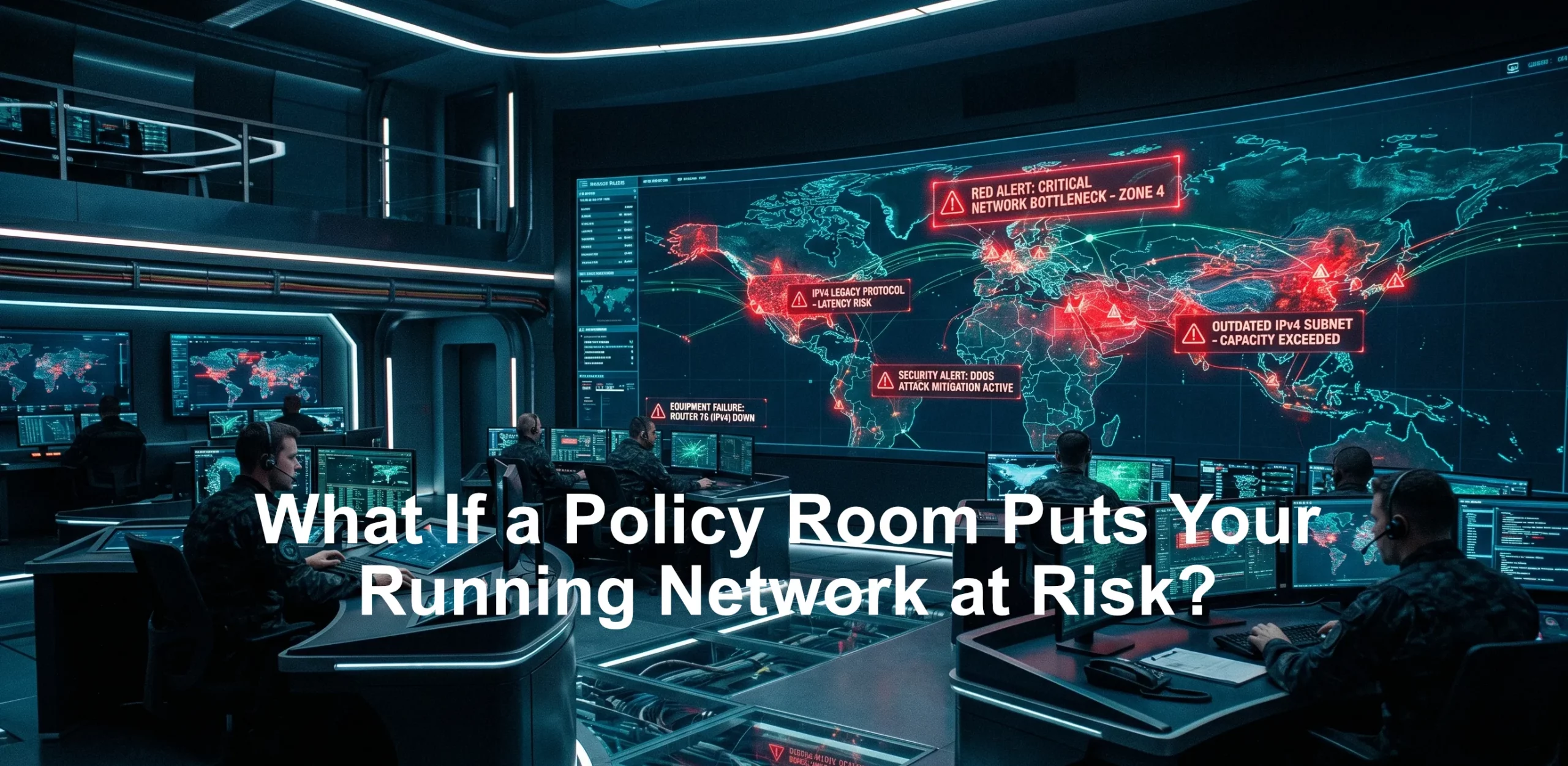
What If a Policy Room Puts Your Running Network at Risk?
Your network may be running today. Your customers may be connected. Your servers may be online. Your IPv4 addresses may already support applications, hosting, VPNs, SaaS platforms, email systems, cloud workloads, and revenue-generating services.
Table of Contents
ToggleBut what if the real risk is not inside your data centre?
What if the risk sits above your network — inside policy rooms, registry processes, transfer rules, administrative interpretations, and “community” decisions that your business does not directly control?
That is the fear many operators ignore until it is too late. IPv4 risk is not only about whether the address works today. It is about whether the system above the address continues to respect the running network tomorrow.
What Is Policy-Room Risk?
Policy-room risk happens when decisions made through registry, governance, or administrative processes create uncertainty for businesses that already depend on live IPv4 resources.
For many companies, IPv4 is not theoretical. It is not a discussion topic. It is not only a registry record. It is part of the production environment. It supports customers, services, contracts, infrastructure, and revenue.
Yet the systems around IPv4 can still be shaped by policy debates, transfer rules, registry interpretations, and institutional processes that may not fully reflect the reality of running networks.
That gap is dangerous. A policy room may speak in the language of process, consensus, or stewardship, but a business feels the impact as delay, uncertainty, restricted mobility, higher cost, operational pressure, or customer disruption.
Why Running Networks Should Come First
The Internet was built around operational reality. Systems that work, route, interconnect, and serve users should not be casually subordinated to abstract process. A registry layer can coordinate records, but it should not forget that the real network lives below the record.
This is why the principle of running networks matters. If an IPv4 block already supports real services, real customers, and real traffic, any process that affects its continuity must be treated with extreme caution.
A business does not survive on policy language. It survives on uptime, reachability, routing stability, customer trust, and predictable access to critical infrastructure.
When administrative process begins to override operational continuity, the risk is no longer theoretical. It becomes a business-continuity problem.
When Policy Risk Becomes Running-Code Betrayal
Policy-room risk becomes more serious when process begins to override the reality of live infrastructure. This is the practical meaning of Running-Code Betrayal: a network may already be operating, customers may already depend on it, and services may already be built around the IPv4 addresses, but administrative interpretation can still place that running network under pressure.
For businesses, the issue is not whether policy discussions should exist. Coordination can be useful when it protects uniqueness, routing confidence, and operational stability. The danger begins when policy language, registry process, or community rhetoric becomes more important than the continuity of networks that are already serving users.
A policy room does not carry the same downside as the operator. If a decision creates delay, transfer uncertainty, routing pressure, or customer disruption, the business operating the network absorbs the cost. The meeting ends, but the operator still has to keep services online.
That is why running networks should come first. A process that claims to protect the internet cannot ignore the infrastructure that is already keeping the internet reachable.
When Process Becomes a Business Threat
Process is useful when it protects stability. Process becomes dangerous when it creates uncertainty without carrying the downside.
A company may build infrastructure around IPv4 addresses for years. It may configure routing, customer systems, DNS records, security policies, VPN access, mail servers, and application environments around those resources.
Then a policy interpretation changes. A transfer becomes harder. A registry process slows down. A provider cannot explain the administrative path. A regional rule affects mobility. A documentation issue becomes an operational blocker. Suddenly, a business that thought its IPv4 strategy was stable finds itself dependent on decisions made elsewhere.
The frightening part is that the network may still be technically functional while the business risk grows above it. Packets may continue to flow, but transferability, continuity, renewal confidence, and future planning may already be under pressure.
The Hidden Cost of Policy Uncertainty
The cost of policy uncertainty is not always visible at the beginning. It may not appear as immediate downtime. It may appear as hesitation, delay, legal review, sourcing difficulty, customer concern, or weaker negotiating power.
For businesses that depend on IPv4, uncertainty can create several risks:
- Delayed deployment because the IPv4 path is unclear
- Difficulty transferring or restructuring address resources
- Higher emergency sourcing cost when plans change
- Reduced confidence from customers or partners
- More time spent on documentation and escalation
- Operational pressure on engineering and network teams
- Business plans becoming dependent on rules outside the company’s control
This is why IPv4 decisions should not be made only by comparing price. A cheap IPv4 arrangement can still become expensive if the policy path, documentation, or registry-aware support is weak.
The real question is not only “Can we get IPv4?” The better question is “Can we keep our network running and our business moving if the policy environment becomes uncertain?”
Before a policy process puts your running network at risk, explore i.lease for structured IPv4 leasing, buying, and selling options.
Further Reading
Frequent Asked Questions (FAQs)
Policy-room risk refers to uncertainty created when registry rules, administrative processes, transfer policies, or governance decisions affect businesses that already depend on live IPv4 infrastructure.
Running network continuity matters because IPv4 addresses often support real services, customers, applications, routing, security systems, and revenue. Any uncertainty around these resources can become a business-continuity issue.
No. IPv4 risk can be technical, commercial, contractual, reputational, administrative, and governance-related. A business should consider all of these layers before leasing or buying IPv4 addresses.
Buying IPv4 may provide stronger long-term control, but it does not remove all policy or registry-related risk. Transfer documentation, recognition, routing readiness, and future management still matter.
i.lease helps businesses reduce IPv4 uncertainty through a continuity-first approach focused on source clarity, routing support, renewal accountability, documentation readiness, and operational reliability. This helps companies avoid weak IPv4 sourcing structures that may expose running networks to policy, transfer, or registry uncertainty.

Transferring IPv4 address space from one organization to another involves more than agreeing on a prefix and a price. A Read more
NAS stands for Network Attached Storage. It is a dedicated storage device that connects to a network and serves files Read more
A botnet is a network of compromised computers or devices running malicious software that lets a single operator control them Read more