Best Practices for Managing Elastic IP Addresses
Elastic IP addresses (EIPs) are a crucial component of cloud networking, especially in Amazon Web Services (AWS). They provide a static, public IPv4 address that can be associated with an instance, ensuring reliability even if the instance is stopped and restarted. However, improper management of Elastic IPs can lead to security risks, unnecessary costs, and operational inefficiencies. This blog post outlines the best practices for effectively managing Elastic IP addresses to optimize performance, reduce costs, and enhance security.
Table of Contents
Toggle1. Allocate and Associate EIPs Only When Necessary
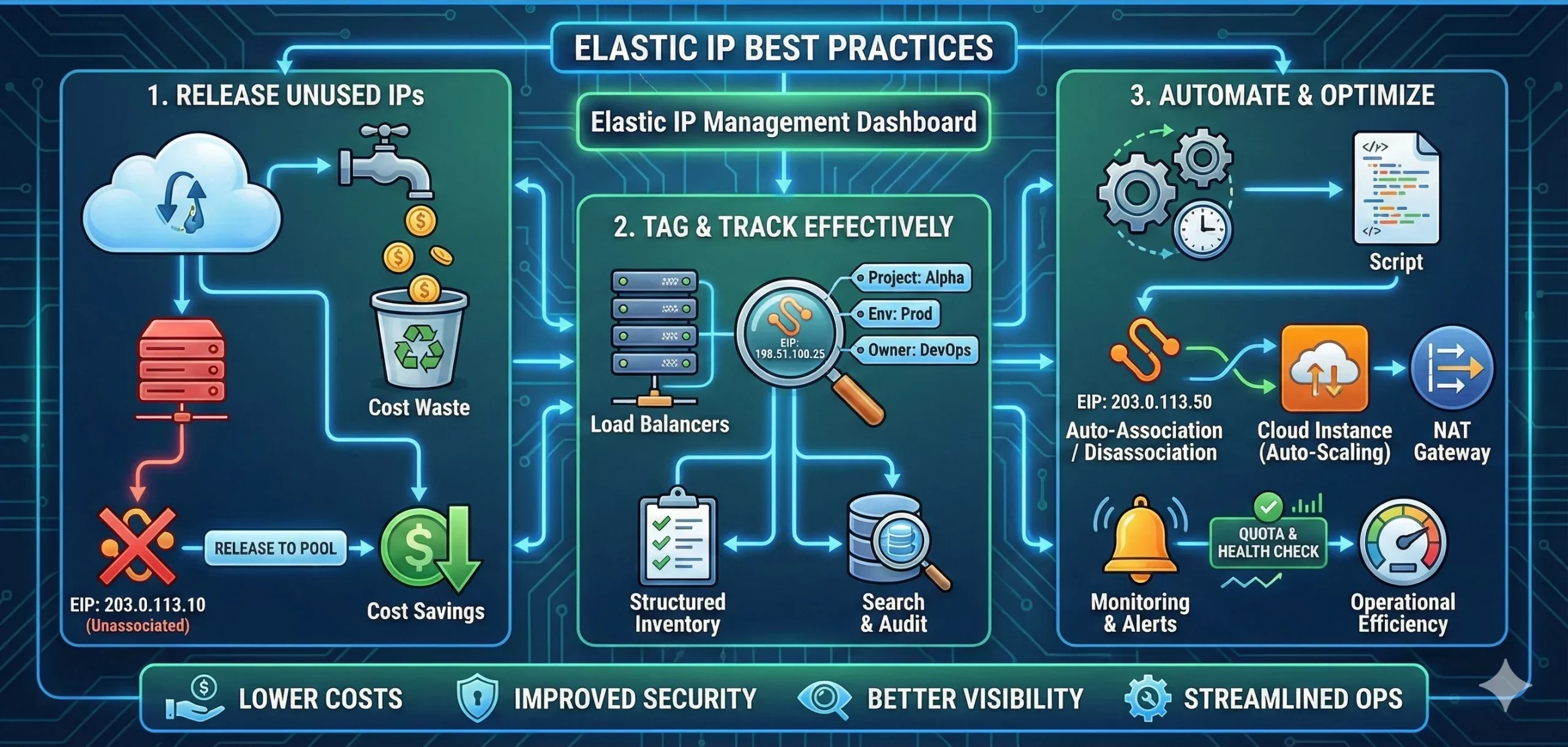
AWS provides a limited number of Elastic IPs per account, and any unused EIPs incur additional costs. To optimize resource utilization:
- Allocate an EIP only when you need a static public IP.
- Release unused EIPs to avoid unnecessary charges.
- Use Elastic Load Balancers (ELB) or AWS PrivateLink instead of EIPs where applicable to reduce reliance on public IPs.
2. Monitor and Audit EIP Usage Regularly
Regularly reviewing EIP allocations helps prevent mismanagement and security vulnerabilities.
- Use AWS Cost Explorer and CloudWatch to track EIP usage and associated costs.
- Set up alerts to notify administrators of unassociated or idle EIPs.
- Audit your account periodically to ensure EIPs are assigned only to necessary resources.
3. Secure Elastic IPs Against Unauthorized Access
Elastic IPs are public and exposed to the internet, making them potential targets for cyber threats. To enhance security:
- Apply strict firewall rules using AWS Security Groups and Network ACLs.
- Implement Identity and Access Management (IAM) policies to restrict who can allocate, associate, and release EIPs.
- Use AWS WAF (Web Application Firewall) to protect applications using EIPs from common web threats.
4. Automate EIP Management with AWS Tools
Automation can reduce the risk of misconfigurations and streamline EIP management.
- Use AWS Lambda functions to detect and release unused EIPs automatically.
- Implement Infrastructure as Code (IaC) with AWS CloudFormation or Terraform to manage EIP allocation and association programmatically.
- Leverage AWS CLI and SDKs to script EIP management tasks, improving operational efficiency.
5. Optimize EIP Usage for High Availability
Elastic IPs can be leveraged to improve uptime and failover strategies.
- Use multiple EIPs to distribute traffic across redundant instances in different Availability Zones.
- Automate failover by associating an EIP with a backup instance in case of primary instance failure.
- Utilize Route 53 for DNS-based failover solutions that work with Elastic IPs.
6. Understand EIP Limits and Request Increases When Needed
AWS imposes limits on the number of Elastic IPs per region to prevent abuse.
- Check your EIP quota in the AWS Service Quotas dashboard.
- Request an increase if your architecture requires additional EIPs, providing justification to AWS support.
Conclusion
Effective management of Elastic IP addresses ensures cost efficiency, security, and high availability. By following these best practices, organizations can optimize their cloud resources, prevent unnecessary expenses, and mitigate security risks. Regular monitoring, automation, and security enhancements play a crucial role in managing EIPs effectively in AWS. Implement these strategies today to streamline your cloud networking operations.
Trusted IPv4 Leasing for Business Growth
Get enterprise-grade IPv4 space quickly, with seamless deployment and end-to-end management.
Buying IPv4 addresses outside proper IP Allocation channels exposes organisations to fraud, legal disputes, operational failures and long-term governance risks.Key Read more
Facing IPv4 shortages, companies must weigh cost, speed, and network growth when choosing a lease plan.Short-term leasing lets you scale Read more
IPv4 地址曾经只是互联网运行所需的基础资源。但在今天,它越来越像一种具有市场价格、可交易、可租赁的数字资产。造成这一变化的原因并不复杂:IPv4 的总量有限,而全球互联网对 IPv4 的需求并没有消失;与此同时,IPv6 虽然早已出现,但迁移进度依然缓慢。这三股力量叠加,正在重新塑造运营商对 IP 地址的看法,也改变了互联网基础设施的经济逻辑。原文将这点概括为“有限供给、持续需求与缓慢转型”,并指出这正在推动 IP 地址成为影响全球电信经济的可交易资产。 IPv4 稀缺并不是新问题 全球互联网至今仍大量依赖 IPv4。这个协议诞生于更早的时代,只能提供大约 43 亿个地址。这个数量在互联网初期似乎足够庞大,但在今天已经明显不够。原文指出,IANA 在 2011 年就已将最后一批大型 IPv4 Read more