IP加密与HTTPS:有什么区别?
Table of Contents
ToggleExplore the distinctions between IP‑layer encryption (IPsec) and HTTPS, their use cases, performance trade‑offs and overlapping functionalities.
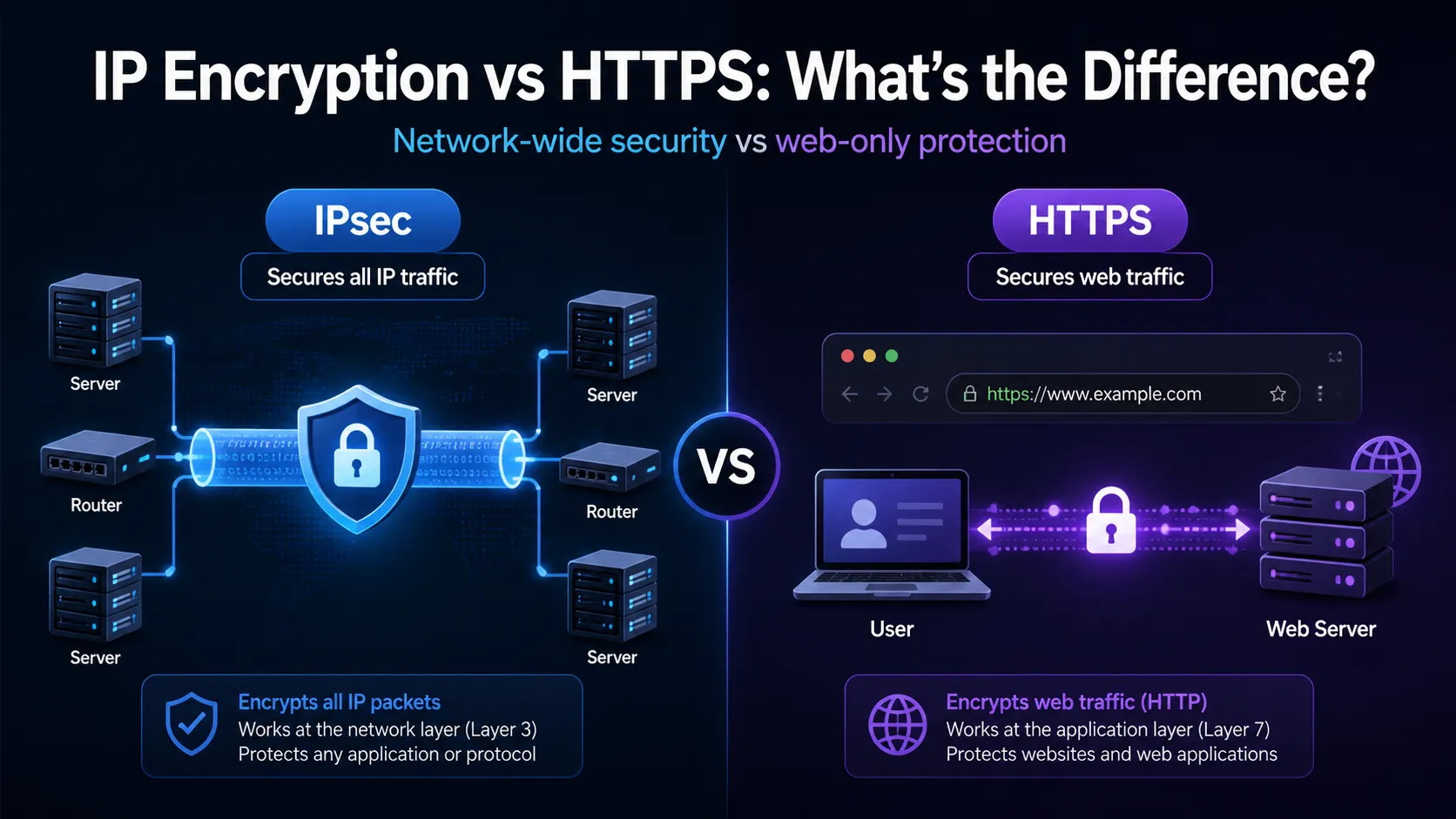
- IPsec secures all IP traffic at the network layer, while HTTPS protects web‑specific traffic at the application layer.
- Both offer powerful encryption, but their scope, complexity and deployment models are quite different.
Introduction
In today’s digital world, encryption is no longer a choice. It is something everyone needs. People and businesses now use the internet for many things, such as banking, medical records, cloud storage, and smart devices. Because of this, keeping data safe while it moves across the internet is very important. There are two common ways to protect internet traffic.
One is IP-layer encryption, often done using IPsec. The other is HTTPS, which protects web traffic. Both use strong methods to hide data and keep it safe. But they work in different places and in different ways. IPsec works at the network layer. It protects all data that moves over the internet, no matter what program sends it. HTTPS works at the application layer. It protects only web traffic, like websites or online forms.
Each method has things it does well and things it does not. Each is better in different situations. Knowing the difference between IPsec and HTTPS is important. It helps network engineers and system administrators make good choices. It also helps people who plan cloud services, VPNs, or website security pick the right tool.
What is IP encryption? An overview of IPsec
IPsec—short for Internet Protocol Security—is a suite of protocols defined by the IETF in the 1990s. Its primary purpose is to encrypt and authenticate IP packets, providing confidentiality, data origin authentication, integrity, and protection from replay attacks.
IPsec operates at the network layer (OSI Layer 3) and supports two main modes: Transport mode and Tunnel mode. It’s widely used for establishing VPNs, connecting remote networks, or encrypting host-to-host traffic.
What is HTTPS?
HTTPS (Hypertext Transfer Protocol Secure) is HTTP with TLS (Transport Layer Security) added. It is made to protect web traffic. TLS gives encryption, checks identity, and keeps the data safe. It stops others from seeing or changing the data while it moves between a user’s browser and a web server.
HTTPS works at the application layer (OSI Layer 7). It protects HTTP requests and responses. It also checks the web server’s identity using X.509 certificates. These certificates come from trusted Certificate Authorities (CAs). They help users know they are talking to the real website.
Network-wide vs web-only
IPsec works at the network layer. It can protect all IP-based communication, no matter what application or protocol is used. This makes it useful for site-to-site VPNs that connect full networks. It also works for client-to-site VPNs, where remote users safely reach internal tools like file servers, email systems, or voice services.
HTTPS works only at the application layer. It protects traffic that uses HTTP. It is good for online tasks like banking, shopping, webmail, and APIs. But it does not protect other types of traffic. This includes things like DNS lookups, file transfers over FTP, or voice calls that use SIP.
IPsec covers more kinds of traffic and works more widely. HTTPS only protects web traffic. But it is simpler to use and easy to set up. Most web servers and browsers already support it. Many websites use HTTPS to make sure user data is safe when sent over the internet.
Deployment and complexity
Establishing IPsec has very high technical requirements. It needs to configure the tunnel endpoints, establish a security alliance (sa) through protocols such as IKE/IKEv2, and manage encryption keys or digital certificates. Deployment usually involves the coordination between network devices and firewall rules, and sometimes also involves custom client software, especially in enterprise or cross-organizational environments.
In contrast, HTTPS is easier to implement. Website administrators usually only need to obtain an SSL/TLS certificate, configure a web server (such as Apache or Nginx), and enable HTTPS support. Tools like Let’s Encrypt further simplify the process by automating certificate issuance and renewal, allowing even small websites or personal projects to access secure network communications.
Performance considerations
IPsec encrypts the entire IP packet, including the header (in tunnel mode), which may lead to an increase in packet size and potential issues with MTU (Maximum Transmission Unit), resulting in fragmentation and higher latency. The negotiation process for establishing a secure connection (for example, through IKE) also introduces additional setup time, especially in dynamic or mobile environments.
On the other hand, HTTPS benefits from modern TLS optimizations such as session recovery, zero round-trip time (0-RTT) in TLS 1.3, and performance improvements in HTTP/2 and HTTP/3, including multiplexing and header compression. These enhancements enable HTTPS to provide strong security with minimal impact on speed, making it highly efficient for web applications.
Security and trust models
IPsec relies on peer-to-peer authentication and typically uses pre-shared keys or X.509 certificates exchanged between devices. Trust is established privately, which means that both ends must be manually configured or managed through an internal key infrastructure. This model works well in closed environments such as enterprise networks, but has poor scalability in public-facing services.
On the contrary, HTTPS relies on a global certificate authority (ca) system to verify the identity of web servers. The browser is pre-installed with a list of trusted cas, allowing users to automatically trust HTTPS connections without manual Settings. This public trust model supports large-scale secure communication on the open Internet, but it also introduces risks such as CA leakage or incorrect certificate issuance – these risks are mitigated through mechanisms such as certificate transparency and OCSP binding.
Use cases: when to choose which?
When it is necessary to ensure the security of all traffic in the network, IPsec can be chosen. For example, site-to-site vpn for connecting branch offices, or client-to-site vpn for remote workers accessing internal systems. This is particularly valuable when multiple applications and protocols (such as file sharing, VoIP, and internal services) require encryption without the need for separate modifications.
When you are concerned about web-based communication (such as protecting websites, REST apis or user portals), please choose HTTPS. It is highly suitable for protecting sensitive user data, such as login credentials, payment information and form submissions. For most public-facing applications, HTTPS offers the simplest and most reliable encryption solution.
Do they overlap?
IPsec and HTTPS can work simultaneously because they encrypt data at different layers of the network stack – IPsec at the network layer and HTTPS at the application layer. In this case, HTTPS traffic is encapsulated in an IPsec tunnel, providing double encryption.
However, such redundancy is rarely necessary in practice. For example, using HTTPS to encrypt web sessions has already ensured confidentiality and authenticity; Repackaging it with IPsec will increase complexity, but it will not significantly improve security. That is to say, organizations with strict compliance requirements or zero-trust architectures may still use these two methods for deep defense or to protect internal routing metadata.
Expert insight
Security experts often highlight that IPsec provides broad protection by securing all traffic at the IP layer, regardless of the application or protocol. This makes it well-suited for network-level defence, especially in enterprise VPNs or between data centres.
In contrast, HTTPS offers targeted protection for web-based services and adds a crucial layer of identity assurance through certificates issued by trusted Certificate Authorities. As cybersecurity analyst Lukas Dolnicek puts it
“IPsec is best for infrastructure-wide encryption, while HTTPS ensures end-user trust and data security on the web.”
— Lukas Dolnicek
Each serves a distinct role in a layered security strategy.
Key differences at a glance
While both IPsec and HTTPS aim to secure data in transit, they differ significantly in terms of their operating layers, coverage, deployment models, and trust assumptions. Here is a breakdown of their most important distinctions:
- Layer of Operation
IPsec works at the network layer (OSI Layer 3), securing data packets regardless of the application that generates them. In contrast, HTTPS operates at the application layer (OSI Layer 7), securing only HTTP-based communication. - Traffic Coverage
IPsec can encrypt all IP-based traffic, including email (SMTP), file transfers (FTP), VoIP (SIP), and custom protocols. HTTPS, however, only secures HTTP and HTTPS traffic, which is ideal for web services and APIs. - Encryption Scope
IPsec protects the entire IP packet, including headers (in tunnel mode), which is crucial for routing protection and metadata confidentiality. HTTPS encrypts just the application data, namely the HTTP headers and body, leaving lower-layer metadata exposed. - Trust Model
IPsec uses pre-shared keys or certificates for mutual authentication between peers. Trust is typically established manually or within a private network. HTTPS relies on a global ecosystem of Certificate Authorities (CAs) to validate server identity, making it scalable for public internet use. - Deployment Complexity
IPsec requires more complex configuration, including key exchange protocols (e.g. IKE/IKEv2), tunnel setup, and potentially dedicated VPN hardware or software. HTTPS is much easier to deploy with modern tools and services like Let’s Encrypt, requiring only a valid TLS certificate and basic web server configuration. - Performance Impact
IPsec can introduce latency and fragmentation due to packet overhead, especially in tunnel mode. HTTPS is optimised for performance through TLS 1.3, session resumption, and protocols like HTTP/2 and HTTP/3, delivering strong security with minimal speed penalties. - Primary Use Cases
IPsec is widely used for VPNs, site-to-site tunnels, and full-network protection in corporate settings. HTTPS is best suited for websites, online services, and API endpoints, where user trust and browser compatibility are key concerns.
When might you use both?
While IPsec and HTTPS are generally used independently—each addressing different layers of the network stack—there are specific scenarios where organisations may choose to deploy both protocols simultaneously.
- High-security environments may require layered encryption
Organisations operating under strict regulatory frameworks—such as banks or government agencies—may use IPsec to secure internal communication across data centres or office branches, protecting all IP traffic and concealing metadata like source and destination IP addresses. - HTTPS ensures public-facing application security
In the same environments, HTTPS is typically employed to secure external web services such as online banking platforms, ensuring encryption at the application layer and providing identity verification through trusted digital certificates. - Zero-trust architectures benefit from protocol layering
In modern zero-trust security models, both protocols may be used together to achieve defence-in-depth. IPsec enforces policy-based encryption across internal network segments, while HTTPS protects individual client-server interactions over HTTP. - Dual-layer encryption introduces operational complexity
Running both protocols in tandem can complicate deployment and maintenance. It may require additional certificate management, custom configurations, and more involved troubleshooting—especially when performance or compatibility issues arise. - Justified only in compliance-driven scenarios
The security benefit of overlapping encryption is often minimal unless explicitly mandated by standards such as FIPS 140-2, HIPAA, or classified system requirements. - Not the default choice for most organisations
For most use cases, a single well-implemented protocol is sufficient. The decision to use both should be guided by risk assessment, data classification, and regulatory obligations, rather than assumptions about added security.
Future directions
Both IPsec and HTTPS continue to evolve in response to emerging security threats, performance demands, and shifts in internet architecture.
On the IPsec side, development is driven by the IETF’s IP Security Maintenance and Extensions (ipsecme) working group, which focuses on refining key exchange mechanisms like IKEv2, supporting modern cryptographic algorithms(e.g., ChaCha20-Poly1305 for improved performance on low-power devices), and enhancing NAT traversal to improve compatibility across diverse networks. As enterprises adopt hybrid cloud and multi-site deployments, IPsec remains critical for establishing secure tunnels across complex topologies.
Meanwhile, HTTPS continues its rapid progression alongside the TLS protocol. The widespread adoption of TLS 1.3has reduced handshake times, deprecated older cryptographic suites, and improved privacy by encrypting more of the negotiation process itself. In parallel, HTTP/3, built on QUIC (a transport protocol running over UDP), introduces lower latency, built-in congestion control, and improved resilience for mobile and real-time applications.
Beyond these protocols, there’s a broader movement toward end-to-end encryption across all layers of the internet stack. Technologies like DNS-over-HTTPS (DoH) and DNS-over-TLS (DoT) aim to secure traditionally exposed DNS queries. Initiatives such as Encrypted Client Hello (ECH) further extend encryption into the TLS handshake, concealing metadata like the hostname from observers.
These advancements reflect a growing consensus: encryption should be the default, not the exception. As attackers become more sophisticated and surveillance capabilities expand, both IPsec and HTTPS will continue to adapt—ensuring the confidentiality, integrity, and authenticity of data in an increasingly interconnected world.
Frequently Asked Questions (FAQs)
No, because HTTPS provides publicly trusted certificate-based identity verification, which IPsec lacks; the two serve different roles in the security stack.
Not significantly—thanks to TLS 1.3 and protocols like HTTP/2 and HTTP/3, HTTPS now delivers security with performance comparable to or even better than HTTP in many cases.
Generally no, unless you also need to secure other types of traffic beyond HTTP, such as internal database access or file sharing over IP.
Yes, they can be layered for added protection in certain scenarios, but it’s rarely necessary outside of environments with strict regulatory or security requirements.
Protocols like DNS-over-HTTPS (DoH) and DNS-over-TLS (DoT) enhance privacy by encrypting DNS queries, and are complementary to HTTPS and IPsec rather than replacements.
Related Blogs
租赁 IPv4 地址可以转移部分伴随完全所有权而来的风险。例如,购买地址可能会让组织暴露于价格波动、长期贬值风险以及信誉管理责任之中。通过 i.Lease 进行租赁,企业可以降低这些风险暴露,并在明确期限内维持可预测的成本,从而支持更可靠的预算规划和风险管理实践。这种方式也简化了基础设施管理,因为租赁供应商通常会负责滥用监控、信誉检查和注册机构协调,使承租方能够专注于核心业务功能,而不是 IP 资产管理。IPv4 租赁并不限于单一行业。托管服务商、云平台、电信公司、SaaS 公司和网络安全企业都可以从租赁中受益。例如,托管服务商可以在无需大量前期投资的情况下扩展服务器部署,而网络安全公司则可以根据客户需求灵活增加地址空间,而无需承诺完全购买。在销售、营销和监管测试中,租赁允许组织在特定地区试运行部署,而无需投入大量资本。这种战略灵活性支持创新,同时帮助企业在 IPv4 稀缺持续存在的市场中保持韧性。利用 i.Lease 进行 IPv4 租赁管理的好处非常清楚:具成本效益的访问、快速部署、信誉安全、可扩展性、地理多样性和持续支持。在 IPv4 地址稀缺且直接购买成本高昂的环境中,通过值得信赖的平台进行租赁,使组织能够维持连接、按需扩展基础设施,并高效管理资源。通过将 IPv4 租赁视为基础设施规划的重要组成部分,而不是临时替代方案,企业可以在应对 IPv4 Read more
IPv4 稀缺性已被广泛理解。许多企业仍然低估的是:地址资源如何被治理和维护所带来的连续性风险。 企业往往在持续使用 IPv4 资源的同时,并没有完全看清支撑这些分配的连续性条件。 对租赁、转让和供应商管理型基础设施的依赖不断增加,正在将 IPv4地址分配 重塑为一个长期治理问题。 IPv4地址分配已悄然成为连续性问题 对许多企业 IT 团队来说,IPv4 地址看起来仍然在运营上保持稳定。 应用程序仍然可以访问。云平台继续扩展。连接服务供应商在没有明显中断的情况下提供服务。从外部看,互联网似乎仍像过去一样运行。 然而,在这种运营稳定性之下,IPv4地址分配的结构已经发生了根本变化。 可自由分配的 IPv4 空间耗尽早已不是新闻。American Registry for Read more
大多数企业进入 IPv4 市场时,目标都很简单。 它们需要地址。 也许是用于托管。 也许是用于 VPN 基础设施。 也许是用于云服务、SaaS 平台、电信扩展、电子邮件系统、网络安全工具,或面向客户的应用程序。 于是,它们开始寻找 IPv4 供应商。 它们比较价格,检查地址块大小,询问交付速度,寻找能够提供所需地址数量的卖方、经纪商或租赁平台。 这种做法可以理解。 但它并不完整。 因为 IPv4 访问不只是供应问题。 它是一个连续性问题。 Read more
租赁 IPv4 地址可以转移部分伴随完全所有权而来的风险。例如,购买地址可能会让组织暴露于价格波动、长期贬值风险以及信誉管理责任之中。通过 i.Lease 进行租赁,企业可以降低这些风险暴露,并在明确期限内维持可预测的成本,从而支持更可靠的预算规划和风险管理实践。这种方式也简化了基础设施管理,因为租赁供应商通常会负责滥用监控、信誉检查和注册机构协调,使承租方能够专注于核心业务功能,而不是 IP 资产管理。IPv4 租赁并不限于单一行业。托管服务商、云平台、电信公司、SaaS 公司和网络安全企业都可以从租赁中受益。例如,托管服务商可以在无需大量前期投资的情况下扩展服务器部署,而网络安全公司则可以根据客户需求灵活增加地址空间,而无需承诺完全购买。在销售、营销和监管测试中,租赁允许组织在特定地区试运行部署,而无需投入大量资本。这种战略灵活性支持创新,同时帮助企业在 IPv4 稀缺持续存在的市场中保持韧性。利用 i.Lease 进行 IPv4 租赁管理的好处非常清楚:具成本效益的访问、快速部署、信誉安全、可扩展性、地理多样性和持续支持。在 IPv4 地址稀缺且直接购买成本高昂的环境中,通过值得信赖的平台进行租赁,使组织能够维持连接、按需扩展基础设施,并高效管理资源。通过将 IPv4 租赁视为基础设施规划的重要组成部分,而不是临时替代方案,企业可以在应对 IPv4 Read more
IPv4 稀缺性已被广泛理解。许多企业仍然低估的是:地址资源如何被治理和维护所带来的连续性风险。 企业往往在持续使用 IPv4 资源的同时,并没有完全看清支撑这些分配的连续性条件。 对租赁、转让和供应商管理型基础设施的依赖不断增加,正在将 IPv4地址分配 重塑为一个长期治理问题。 IPv4地址分配已悄然成为连续性问题 对许多企业 IT 团队来说,IPv4 地址看起来仍然在运营上保持稳定。 应用程序仍然可以访问。云平台继续扩展。连接服务供应商在没有明显中断的情况下提供服务。从外部看,互联网似乎仍像过去一样运行。 然而,在这种运营稳定性之下,IPv4地址分配的结构已经发生了根本变化。 可自由分配的 IPv4 空间耗尽早已不是新闻。American Registry for Read more
大多数企业进入 IPv4 市场时,目标都很简单。 它们需要地址。 也许是用于托管。 也许是用于 VPN 基础设施。 也许是用于云服务、SaaS 平台、电信扩展、电子邮件系统、网络安全工具,或面向客户的应用程序。 于是,它们开始寻找 IPv4 供应商。 它们比较价格,检查地址块大小,询问交付速度,寻找能够提供所需地址数量的卖方、经纪商或租赁平台。 这种做法可以理解。 但它并不完整。 因为 IPv4 访问不只是供应问题。 它是一个连续性问题。 Read more